Bitcoinist.com
https://bitcoinist.com Mon, 31 May 2021 16:08:47 +0000 en-US hourly 1 https://wordpress.org/?v=5.7.2 https://bitcoinist.com/wp-content/uploads/2021/04/cropped-cropped-cropped-Icon-32×32.png
https://bitcoinist.com 32 32
https://bitcoinist.com/this-is-why-druckenmiller-and-tudor-jones-changed-their-mind-on-bitcoin/?utm_source=rss&utm_medium=rss&utm_campaign=this-is-why-druckenmiller-and-tudor-jones-changed-their-mind-on-bitcoin https://bitcoinist.com/this-is-why-druckenmiller-and-tudor-jones-changed-their-mind-on-bitcoin/#respond
Mon, 31 May 2021 16:08:47 +0000
This Is Why Druckenmiller And Tudor Jones Changed Their Mind On Bitcoin
In 2017, Bitcoin reached an all-time high of $20,000. By 2018, the price of the first cryptocurrency by market cap dropped by more than 50%. What happens later caught the attention of two legendary investors, Stan Druckenmiller, founder of Duquesne Capital, and Paul Tudor Jones, founder of Tudor Investment Corporation.
Druckenmiller has been giving interviews to several news outlets and analyst John Street Capital compiled them via his Twitter handle. The legendary investor expressed concerns about the current policy exercise by central banks around the world. He believes these institutions are making fiat currency “more questionable”.
For the first time, Druckenmiller revealed that during a phone call with Tudor Jones, he learned a fact that made him change his mind on Bitcoin and the potential of cryptocurrencies to become a hedge against central bank inflationary policies. Tudor Jones asked Druckenmiller the following:
“Do you know that when Bitcoin went from $17,000 to $3000 that 86% of the people that owned it at $17,000, never sold it?” Druckenmiller replied: Well, this was huge in my mind. So here’s something w/ a finite supply & 86% of the owners are religious zealots.
This conviction, Bitcoin holders’ diamond hands, and the economic outlook forced Druckenmiller and Tudor Jones to consider whether they should buy Bitcoin. As they revealed later after that, they became BTC investors during 2020.
Bitcoin, The New Gold For Younger Generations
Bitcoin has additional characteristics which the legendary investor used to measure its potential. Tudor Jones told Druckenmiller that the cryptocurrency became a brand after 13 years since its inception. The cryptocurrency achieved this with no marketing team or a CEO to command such strategy, it is driven by holders, its network effect, and the guarantee of its limited supply.
Duquesne Capital founder has only one regret when it comes to BTC, like many investors, he feels that he should have bought more.
I tried to buy $100M of $BTC at $6,200. It took me 2 weeks to buy $20M. I bought it all around $6,500, I think. So like an idiot, I stopped buying it.
Druckenmiller added that there is a generational shift led by “kid on the West Coast” and the younger investors. They consider Bitcoin as Druckenmiller saw Gold, a store of value, insurance against fiat currencies.
When comparing Ethereum and Bitcoin, Druckenmiller believes the latter has won the “store of value game”. He based his opinion on 3 points, BTC has a brand that has existed for around 13 years and a finite supply. The legendary investors claim ETH could be the “MySpace” of the crypto industry.
I’m a little more skeptical of whether it can hold its position. It reminds me a little of MySpace before $FB. Or maybe a better analogy is Yahoo before Google came along. Google wasn’t that much faster than Yahoo, but it didn’t need to be. All it needed to be was a little bit faster and the rest is history.
He predicts more appreciation for BTC’s price if the U.S. Federal Reserve and its Chairman, Jay Powell, “keep acting like he’s been acting”. As long as this continues, BTC and Gold will have wind to keep rising.
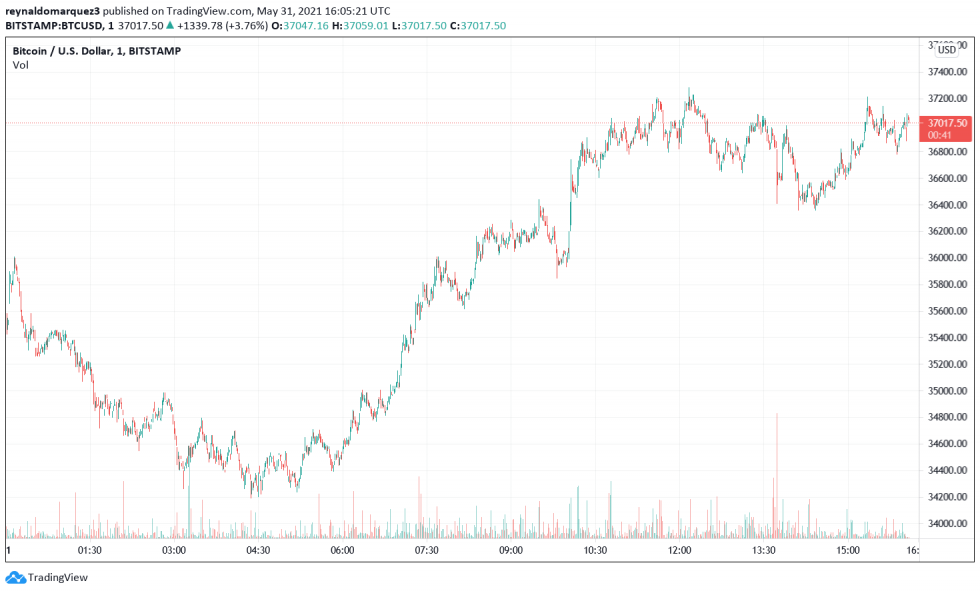
At the time of writing, BTC trades at $36,962 with small gains in the 1-hour and daily chart. In the weekly and monthly charts, BTC has a 5.9% profit and 35.9% loss, respectively.
]]>
https://bitcoinist.com/this-is-why-druckenmiller-and-tudor-jones-changed-their-mind-on-bitcoin/feed/ 0
https://bitcoinist.com/most-profitable-signal-bitcoin-2021/?utm_source=rss&utm_medium=rss&utm_campaign=most-profitable-signal-bitcoin-2021 https://bitcoinist.com/most-profitable-signal-bitcoin-2021/#respond
Mon, 31 May 2021 15:51:31 +0000
The Most Profitable Signal In Bitcoin Is Back And About To Trigger
Bitcoin price is still down 40% from recent highs, forcing investors to face the reality that the bull run could be over. And while that scare and related selloff certainly shook out even the strongest of hands, those that are still holding could end up reaping enormous profits.
That’s because even though things appear to be extremely bearish at the moment for crypto, the most profitable buy signal in Bitcoin history is about to trigger. Here’s a look at what this means and why the last signal in each bull market is the strongest of them all.
Bitcoin Hash Ribbons Show Miner Capitulation, Buy Signal Is Coming
The first ever cryptocurrency has had its most profitable year on record, tripling in value within the first three months of the year. After a shocking move up, however, the market corrected and it caused chaos in newcomers to the volatile asset class.
Related Reading | Why The Recent China FUD Is Bullish For Bitcoin
More than 50% was bled out of Bitcoin price in just days following the local top – enough downside to question if it was the top of the bull market itself. Several indicators say as such, but the masses deny any chance of that happening – $100,000 BTC or bust.
However, stubborn as they may be, those with so-called diamond hands might end up with profits worth their weight in the precious gemstone.
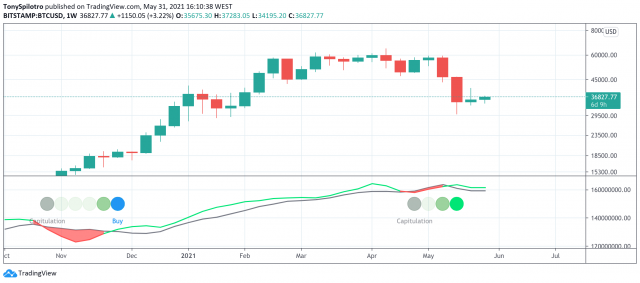
The hash ribbons are about to trigger a buy signal | Source: BTCUSD on TradingView.com
What The Most Profitable Signal In Crypto Means For The Bull Run
The chart above shows the “hash ribbons” created by crypto fundamental expert Charles Edwards, which currently indicate that BTC miners are capitulating.
During selloffs, miners are forced the sell coins to fund operations. In theory, Edwards’ tool denotes when that’s happening. It also has a very fortunate side effect of being the most profitable buy signal in crypto history.
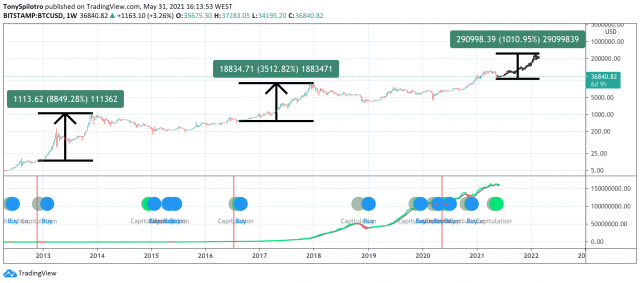
The last signal of each bull market is the most powerful | Source: BTCUSD on TradingView.com
In the past, the last buy signal of each cycle led to another 8,000% and 3,500% respectively. Each cycle had a number of buy signals before the grand finale, but it is the last signal that gives the indicator its reputation of profitability.
Related Reading | SEC Warns Investors Of “Highly Speculative” Bitcoin Risk
Past buy signals from the current market cycle all have resulted in upside worth bragging about. After the December 2018 Botton, BTC rose by 300% and the most recent signal resulted it more than 500% returns.
With the cryptocurrency already at $35,000 per coin and only now about to trigger this monumental buy signal, how much further could the cryptocurrency climb?
The above chart shows an example of how only another 1,000% is necessary to reach $300,000 per BTC – an ROI which is meager to what the hash ribbons called out ahead of time during past bull rallies.
Featured image from iStockPhoto, Charts from TradingView.com
]]>
https://bitcoinist.com/most-profitable-signal-bitcoin-2021/feed/ 0
https://bitcoinist.com/holoride-to-integrate-nfts-and-blockchain-for-its-in-vehicle-entertainment-experience/?utm_source=rss&utm_medium=rss&utm_campaign=holoride-to-integrate-nfts-and-blockchain-for-its-in-vehicle-entertainment-experience https://bitcoinist.com/holoride-to-integrate-nfts-and-blockchain-for-its-in-vehicle-entertainment-experience/#respond
Mon, 31 May 2021 15:36:00 +0000
Holoride To Integrate NFTs and Blockchain For Its In-Vehicle Entertainment Experience
The world’s first immersive in-vehicle media platform is being developed by holoride. Holoride will provide contents that changes to vehicle motion, journey time, and route by processing motion and location-based data in real-time by integrating blockchain and NFTs.
Holoride Is Employing Trendy Tech
Holoride is building an ecosystem around in-car experiences by combining three hot technologies for 2021: immersive media, blockchain, and non-fungible tokens (NFTs).
The company, which secured a $12 million Series A in April, announced it would be integrating Elrond blockchain into its tech stack to bring transparency to its community of automobile makers and content creators. Holoride wants to leverage non-fungible tokens (NFTs) to entice developers to provide more content on the platform in exchange for a higher return on token sales, as well as to attract customers who want to customize their in-car experience.
Audi-backed startup @holoride is now deploying blockchain technology powered by @ElrondNetwork for its platform. The company is advancing the future of in-vehicle entertainment >> https://t.co/sF7RsCVZlO#Audi #VirtualReality #blockchain #technology @TechCrunch
— Audi (@AudiOfficial) May 31, 2021
Elrond is a blockchain-based cryptocurrency with strong scalability, interoperability, and throughput that sets it apart from other digital currencies. In the emerging internet economy, the currency aspires to be a quick platform for distributed apps and enterprise use cases. Elrond’s creators provide 30% smart contract royalties to coin developers and have cooperated with a number of well-known companies, including Samsung of South Korea. Microsoft has also allowed Elrond for payments to buy apps, games and other digital content. This integration is a welcome development for Holoride and Elrond.
Although, blockchain isn’t required for Holoride’s immersive in-vehicle media platform to work. Its passenger experiences are synced to the vehicle’s real-time motion and location-based data, so content changes to the vehicle’s movement.
“We said we want to connect all our ecosystem partners in a very fair and transparent manner from the beginning, and blockchain technology delivers exactly on that,” CEO and founder Nils Wollny said. “Every transaction and engagement can be stored in the blockchain. For car manufacturers, they can see how much time was spent with holoride experiences in their cars, and for content creators it’s transparent on how much time was spent with their title they have created for our platform.”
Related article | Taking A Walk On The Wild Side With Wilder World’s Immersive 3D Universe
Riding On The NFT Craze
Wollny hopes the enticement of buying or collecting NFTs while immersed in holoride’s experiences will lead to more engagement. For holoride, an NFT might start by connecting elements in the virtual world to locations or events in the real world.
“Imagine people are traveling in their virtual vehicle, maybe it’s a spaceship or a submarine, as their physical body is in a car driving through the real world,” said Wollny. “They might pass by a certain location where a content creator decided to put something passengers can collect on their way.”
The future of holoride’s NFTs is largely determined by how deeply passengers become engrossed in their in-car experiences, prompting them to seek attachment and personalisation in the form of digital tokens. Wollny adds:
“We have our eyes set on the future, and this technology will help get us there. We’re thrilled to continue moving towards our wider market launch next year and show everyone what’s yet to come.”
Related article | Let The Bidding Begin: The First NFT Patent?
Featured image from Pixabay, Charts from TradingView.
]]>
https://bitcoinist.com/holoride-to-integrate-nfts-and-blockchain-for-its-in-vehicle-entertainment-experience/feed/ 0
https://bitcoinist.com/dot-it-like-its-hot-securing-polkadot-through-universal-staking/?utm_source=rss&utm_medium=rss&utm_campaign=dot-it-like-its-hot-securing-polkadot-through-universal-staking https://bitcoinist.com/dot-it-like-its-hot-securing-polkadot-through-universal-staking/#respond
Mon, 31 May 2021 14:47:58 +0000
DOT It Like It’s Hot: Securing Polkadot Through Universal Staking
Polkadot has lowered the minimum staking threshold from 300 DOT to just 1 DOT after its most recent update. The move makes it one of the most accessible networks to participate on as a nominator, without using an exchange as a middleman.
Prior to this new development, retail DOT holders were forced to stake-as-a-service on centralized platforms like Kraken, Kucoin, and Huobi. Now, virtually anyone can participate directly on Polkadot.
For comparison, Ethereum requires 32 ETH (approximately $90,000) to delegate on their network. Now that Polkadot only requires only 1 DOT to earn passive staking rewards, more community members will be able to bolster network security and assist in fending off potential DoS attacks.
In his recent publication ‘Limits of Blockchain Scalability’ Vitalik Buterin stressed the importance of community participation on PoS networks:
“If you have a community of 37 node runners and 80,000 passive listeners that check their signatures and block headers, the attacker wins. If you have a community where everyone runs a node, the attacker loses.”
Ultimately, the best defense for protocols from bad actors is building a culture of users validating the chain. Lowering the minimum staking requirement to one DOT allows anyone in the Polkadot community to participate in earning passive income, no matter the size of their bankroll.
Institutional Investors Turn Their Gaze Towards PoS
Headlines like China reiterating anti-speculation laws from a few years ago and mounting environmental concerns about mining pulled the rug out from over-leveraged traders and rekt the crypto capital markets. Nearly a trillion dollars in market capitalization was erased – but with no government bailout required.
After the dust settled, billionaires slowly began fawning over cryptocurrencies and touting their store of value properties. Mark Cuban confirmed that he invested in layer 2 scaling solution Polygon, Carl Ichan mentioned about getting into crypto in “big way”, and even Ray Dalio admitted he had “some bitcoin.” All three were cryptocurrency skeptics turned believers.
Goldman Sachs and other banks also made bold predictions that Ethereum will flip Bitcoin as the premier crypto store of value, citing its programmability for dApps and smart contracts. However, there are lingering concerns among the crypto community as to when Ethereum 2.0 will actually launch.
At the time of writing, DOT is currently trading at $22, down 52% from its ATH of almost $50. Significantly, DOT stakers are subjected to a 28-day lock up. This helps remove any added sell pressure and maintains a solid price floor. In addition, Polkadot’s transaction costs are much more affordable than using Ethereum’s congested network.
Coexisting Chains
As much as Polkadot is advertised as an Eth Killer, Polkadot isn’t necessarily competing with Ethereum. The two can coexist, with Ethereum forming the foundation for defi while Polkadot can provide the supplemental framework for new interoperable chains and cross-chain compatibility. This is facilitated by Polkadot’s “common good” Parachains which will be used as bridges to connect other blockchains.
With institutional shift towards Ethereum as a tech investment for its programmability properties, it seems only a matter of time before a more scalable and cross-chain compatible solution like Polkadot pops up on their radar.
Polkadot’s heterogeneous multi-chain platform achieves consensus through a Nominated Proof-of-Stake (NPoS) network, designed for validators and nominators to maximize chain security.
The Relay Chain of Polkadot acts as the central nervous center where DOT holders can participate as validators to coordinate security measures for active parachains (short for parallelized chain). While Polkadot’s Relay Chain does not support application development nor smart contracts, it serves three primary goals: security, interoperability, and governance. The Relay Chain also allows users to stake their DOT, requiring as little as a 1 DOT since the recent upgrade.
Parachains on Polkadot are application-specific sub-chains used for dApps, smart contract platforms and other use cases. Rather than having to bootstrap users for their network, projects that choose to build on Parachains will lease out the Relay Chain’s validators. This way they can focus on building their visions for their end-users instead of marketing.
Having community members engage in staking for consensus is essential toward continued success. This ensures all members of the Polkadot ecosystem, no matter how large or small, can participate in staking.
Parachains Going Live Soon
Polkadot is currently testing and optimizing its upcoming Parachains on Kusama (the canary test-network). Following the completion of an audit, Parachains will launch sometime in the next few months.
Polkadot has quietly built out its ecosystem full of stablecoin, smart contract platform and open parachain slots to be auctioned off at a later date. Most of these protocols will focus on building the necessary infrastructure for defi on Polkadot.
Now that Polkadot has constructed a more inclusive staking environment, it’s well positioned to tackle the bottlenecks of blockchain maximalism by advancing multi-chain interoperability and scaling.
]]>
https://bitcoinist.com/dot-it-like-its-hot-securing-polkadot-through-universal-staking/feed/ 0
https://bitcoinist.com/bitcoinist-book-club-the-bitcoin-standard-chapter-3-part-2-history/?utm_source=rss&utm_medium=rss&utm_campaign=bitcoinist-book-club-the-bitcoin-standard-chapter-3-part-2-history https://bitcoinist.com/bitcoinist-book-club-the-bitcoin-standard-chapter-3-part-2-history/#respond
Mon, 31 May 2021 08:03:42 +0000
Bitcoinist Book Club: “The Bitcoin Standard” (Chapter 3, Part 2: History)
Welcome back, Saifedean Ammous’ “The Bitcoin Standard” lovers! Two episodes in a row, because we are committed to doing a whole chapter each week. The last time, we learned why humanity chose gold as the soundest form of money. Now, we’re opening the history books and telling you exactly how everything came to pass.
Needless to say, this chapter right here explains the current state of our present world. The parallels between the two periods of time are breathtaking and… a little scary. However, that’s exactly what we’re here to understand. How did we get here? And, why is Bitcoin essential for future human development? Keep reading to find out.
Before we get into it, let’s explain what we’re doing one more time:
About The Coolest Book Club On Earth
The Bitcoinist Book Club has two different use cases:
1.- For the superstar-executive-investor on the run, we’ll summarize the must-read books for cryptocurrency enthusiasts. One by one. Chapter by chapter. We read them so you don’t have to, and give you just the meaty bits.
2.- For the meditative bookworm who’s here for the research, we’ll provide liner notes to accompany your reading. After our book club finishes with the book, you can always come back to refresh the concepts and find crucial quotes.
Everybody wins.
So far, we’ve covered:
Let’s keep on trucking with “Chapter 3: Monetary Metals.“
Remember book lovers, any resemblance to our current reality in what you’re about to read is NOT pure coincidence.
Roman Golden Age and Decline
- In Rome, the common coin was the Denarius, which contained 3.9 grams of silver.
- Julius Caesar created the Aureus, which contained 8 grams of gold, “and was widely accepted across Europe and the Mediterranean, increasing the scope of trade and specialization in the Old World.”
- After 75 years of economic stability, Emperor Nero was the first to introduce “coin clipping.” The throne collected the population’s coins, melted them, and minted new coins with less gold and silver. Devaluation raised its ugly head.
- To pay for the “lavish lifestyle” of the upper class, the ever-increasing military spending, and for “unproductive citizens living off the emperor’s largesse,” they reduced the Aureus to 7.2 grams, and the Denarius to 3.41 grams.
- Through the years, of course, the emperors kept debasing the coins. More than 200 years after Nero, Emperor Diocletian introduced the Solidus, a replacement coin with only 4.5 grams of gold. Under his watch, the Denarius ended up having just a silver coating to “cover its bronze core.”
- The author quotes Ferdinand Lips, “With money so unreliable and debased, speculation in commodities became far more attractive than producing them.”
- This preceded the fall of Rome, “As taxes increased and inflation made price controls unworkable, the urbanites of the cities started fleeing to empty plots of land where they could at least have a chance of living in self-sufficiency, where their lack of income spared them having to pay taxes.”
Byzantium and the Bezant
- It was time for Constantine the Great. He kept the Solidus at 4.5 grams and “started minting it in large quantities.” Then, he “established Constantinople at the meeting point of Asia and Europe, birthing the Eastern Roman Empire, which took the solidus as its coin.”
- Rome fell, “Byzantium survived for 1,123 years,” and the Solidus changed names. It became the Bezant.
- Approximately 500 years after Constantine the Great, the Byzantium Empire started to devalue the coin again. Everything declined little by little. Almost 500 years after that, the Empire “was overtaken by the Ottomans.”
- During that time, the Bezant reached Islamic lands. Using similar weight and size, they created the Dinar. The Arab and Muslim civilizations never devalued their coins, for that reason the Dinar continues to circulate to this day.
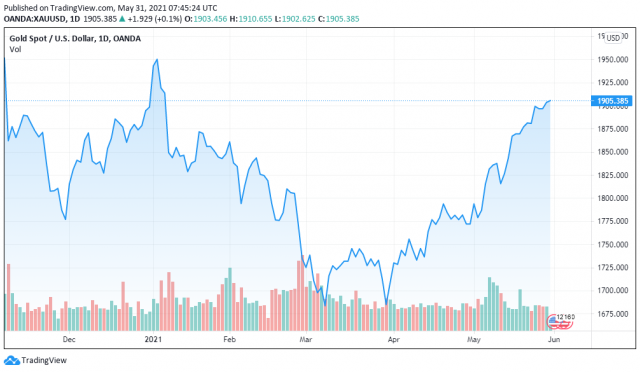
Gold price chart on Oanda | Source: XAU/USD on TradingView.com
The Renaissance
- After Rome, it was time for Feudalism. The feudal lords controlled all the gold, the peasants transacted in copper and bronze coins. With those metals, it was easy to inflate the supply when needed.
- Europe fell into the Dark Ages, as inflation and taxation caused that, “New generations of Europeans came to the world with no accumulated wealth passed on from their elders, and the absence of a widely accepted sound monetary standard severely restricted the scope for trade.”
- The transition to the Renaissance began with “city-states adopting a sound monetary standard.” Florence minted the Florin and, seeing its success, Venice minted the Ducat. Less than 20 years later, “150 European cities and states had minted coins of the same specifications as the florin.”
- At this time, silver coins played an integral role. Its lower value made it the metal of choice for small transactions.
- The problem was the fluctuations in the price relationship between the two metals. So, “As sovereigns set an exchange rate between the two commodities, they would change holders’ incentives to hold or spend them.”
Paper money
- The two technologies that brought about the modern banking system were: the telegraph and the trains. As soon as they existed, “it became increasingly feasible for banks to communicate with each other, sending payments efficiently across space when needed and debiting accounts instead of having to send physical payments.”
- The banks kept precious metals in vaults and emitted cheques and bills. This solved gold’s divisibility problem, so silver was no longer needed.
- Still, some nations decided to store silver instead of gold. We can still feel the consequences of that decision. Britain chose gold from the very beginning and achieved “economic supremacy” One by one, Europe followed.
- The last countries to join the gold standard were India in 1898 and China and Hong Kong in 1935. By the time they did it, India’s coins had lost 56% of their value, and China’s 78%.
La Belle Époque
- By the 19th Century, most of Europe was under the same monetary standard. “allowing the improvements in telecommunications and transportation to foster global capital accumulation and trade like never before.”
- The only difference between the coins was the weight of the gold they were made from. “The British pound was defined as 7.3 grams of gold, while the French franc was 0.29 grams of gold and the Deutschmark 0.36 grams.”
- Sound money brought prosperity, which brought la belle époque, or the beautiful era. ”Some of the most important technological, medical, economic, and artistic human achievements were invented during the era of the gold standard.”
- Gold became too valuable to carry around and tended to go into vaults. However, “Gold being centralized made it vulnerable to having its monetary role usurped by its enemies.” Namely, the government, “the banks and central banks holding the gold could create money unbacked by physical gold and use it for settlement.”
A new kind of devaluation arose its ugly head. It always comes to that. And basically, that’s where we are now, in the paper money era. Throughout the whole 20th century, government and central banks progressively got rid of gold as a medium of exchange and as a unit of account. It still is a store of value, though.
Images by Unsplash | Charts by TradingView
]]>
https://bitcoinist.com/bitcoinist-book-club-the-bitcoin-standard-chapter-3-part-2-history/feed/ 0
https://bitcoinist.com/bitcoinist-book-club-the-bitcoin-standard-chapter-3-part-1-why-gold/?utm_source=rss&utm_medium=rss&utm_campaign=bitcoinist-book-club-the-bitcoin-standard-chapter-3-part-1-why-gold https://bitcoinist.com/bitcoinist-book-club-the-bitcoin-standard-chapter-3-part-1-why-gold/#respond
Sun, 30 May 2021 02:17:01 +0000
Bitcoinist Book Club: “The Bitcoin Standard” (Chapter 3, Part 1: Why Gold?)
Welcome back, Bitcoin lovers! For those who’re just tunning in, we’re currently exploring “The Bitcoin Standard” by Saifedean Ammous. When we finish with the third chapter, you’ll know exactly why humanity picked gold as the most precious of metals and its form of money of choice. The reasons are unarguable. Humanity was extremely clever to do so.
However, you need this info before we get into it.
Related Reading | NFT Sales Volume Plummets From Recent Highs: Is the Hype Over?
About The Coolest Club On Earth
The Bitcoinist Book Club has two different use cases:
1.- For the superstar-executive-investor on the run, we’ll summarize the must-read books for cryptocurrency enthusiasts. One by one. Chapter by chapter. We read them so you don’t have to, and give you just the gold-y bits.
2.- For the meditative bookworm who’s here for the research, we’ll provide liner notes to accompany your reading. After our book club finishes with the book, you can always come back to refresh the concepts and find crucial quotes.
Everybody wins. Gold medals.
So far, we’ve covered:
Let’s start with “Chapter 3: Monetary Metals.“
 Metals made obsolete the “artifact money” we deep-dived into in the previous chapter. Coins were easier to carry, highly salable, accepted everywhere, and resistant to all kinds of weather. Also, the difficulty metal mining presented at the time made it impossible to increase the supply significantly enough.
After an experimentation period, humanity settled down on three. Gold for serious transactions, silver for day-to-day life, and copper for small transactions. Those metals were rare enough, and, “Gold’s virtual indestructibility, in particular, allowed humans to store value across generations, thus allowing us to develop a longer time horizon orientation.”
Metal coins were “the prime form of money for around 2,500 years.” Especially gold coins. Nevertheless, the system was flawed. First of all, the price of those three metals fluctuated, making it hard for people to keep track of what they owned. The most volatile was, “silver, which experienced declines in value due to increases in production and drops in demand.”
The biggest flaw, however, was that “governments and counterfeiters” could reduce the metal content of these coins, thus reducing their purchasing power. This early form of devaluation transferred some of the value of each coin to whoever kept the missing metal. The real problem, though, was that “The reduction in the metal content of the coins compromised the purity and soundness of the money.”
Enter paper (backed by gold)
Technology and sophistication lead humanity to paper. As time went by, individuals began transacting with “checks backed by gold in the treasuries of their banks.” This made silver obsolete because it made gold infinitely divisible. However, the system had a “tragic flaw” that echoes into the present:
By centralizing the gold in the vaults of banks, and later central banks, it made it possible for banks and governments to increase the supply of money beyond the quantity of gold they held, devaluing the money and transferring part of its value from the money’s legitimate holders to the governments and banks.
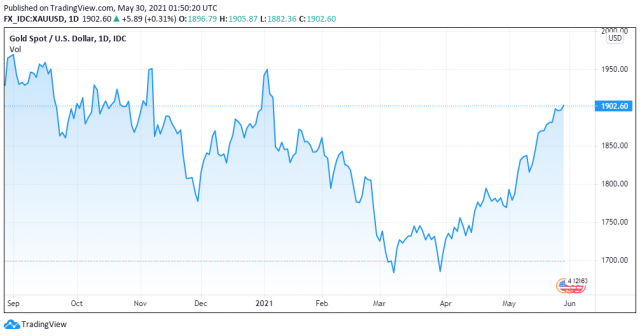
Gold price chart on IDC | Source: XAU/USD on TradingView.com
But seriously, why gold?
Humanity tried it all and made its choice. The absolute victory of gold had two chemical causes:
First, gold is so chemically stable that it is virtually impossible to destroy, and second, gold is impossible to synthesize from other materials (alchemists’ claims notwithstanding) and can only be extracted from its unrefined ore, which is extremely rare in our planet.
Related Reading | Whole Earth Coins: A Digital Incentive for Crowdsourcing Infrastructure Data
And nowadays, the reasons are more solid than ever. Gold is virtually indestructible, so, almost everything that we’ve extracted from the earth is still around.
This all means that the existing stockpile of gold held by people around the world is the product of thousands of years of gold production, and is orders of magnitude larger than new annual production.
And that means that it’s “practically impossible for goldminers to mine quantities of gold large enough to depress the price significantly.” That extreme difficulty in production makes gold “hard money.” And the metal is still scarce enough to be sound money and a wise investment.
You’ll have to figure out how to store it and keep it safe, of course, but a wise investment nonetheless.
Next time, we’ll finish chapter 3 by exploring how did this process played out. Historically speaking.
Images by Unsplash | Charts by TradingView.com
]]>
https://bitcoinist.com/bitcoinist-book-club-the-bitcoin-standard-chapter-3-part-1-why-gold/feed/ 0
https://bitcoinist.com/nfts-in-a-nutshell-a-weekly-review-5/?utm_source=rss&utm_medium=rss&utm_campaign=nfts-in-a-nutshell-a-weekly-review-5 https://bitcoinist.com/nfts-in-a-nutshell-a-weekly-review-5/#respond
Sat, 29 May 2021 18:24:44 +0000
From major art gallery sales to Nobel Prize-winners, NFTs continue to hit the headlines. Let’s take a look at the past week’s action in non-fungible tokens.
This Week’s Non-Fungible Token News
Andy Warhol Foundation NFTs Yield Over $3M
Last week’s Nutshell called out the Andy Warhol Foundation collaboration with Christies; this week, “Andy Warhol: Machine Made” hit the market. Five unique NFTs brought in nearly $3.4M, with net proceeds going to support the annual funding of The Andy Warhol Museum and further Warhol Foundation efforts. The global auction brought in final buyers from the U.S., Asia, and Europe.
More Memes!?!
Classic memes have hit the NFT market this week as ‘Harambe’ and ‘Charlie Bit My Finger’ have hit the market.
YouTube classic ‘Charlie Bit My Finger’ sold this week for over $760K; while speculation was abound that the buyer would have the original video removed from YouTube, the buyer stated that it would not be doing so, citing the video’s importance to “popular culture”.
Additionally, ‘Harambe’, the gorilla who was killed and thrust into pop culture as a viral 2016 meme, will soon be the latest internet meme to hit the market as an NFT. Harambe follows other major cultural NFTs, such as ‘Nyan Cat’, ‘Disaster Girl’, and more.
Related Reading | The Rapper Who Bought Eminem’s NFT For $100K And Transformed It Into 7M Views
Major Musicians? Platform OneOf Is Working On That
Partnering with Quincy Jones and his production company, music platform OneOf announced a substantial fundraising round this week. The platform is looking to take an environmentally-friendly approach to tokenizing musician’s work, and also emphasizing accessibility for fans. Artists expected to feature in the debut release include Whitney Houston, John Legend, Doja Cat, and more.
The $10M CryptoPunk
Sotheby’s is bringing a standalone CryptoPunk to the market, the auction house announced on Twitter this week. “Covid Alien” CryptoPunk #7530 will be up for auction on June 10th, and is expected to command anywhere from $5-10M+. The most recent alien sale went for 4,200 ETH (over $10M in today’s value).
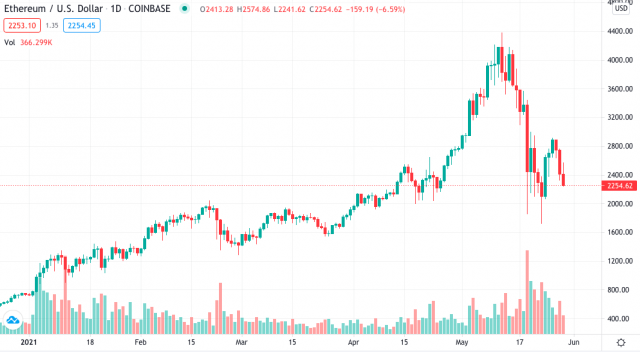
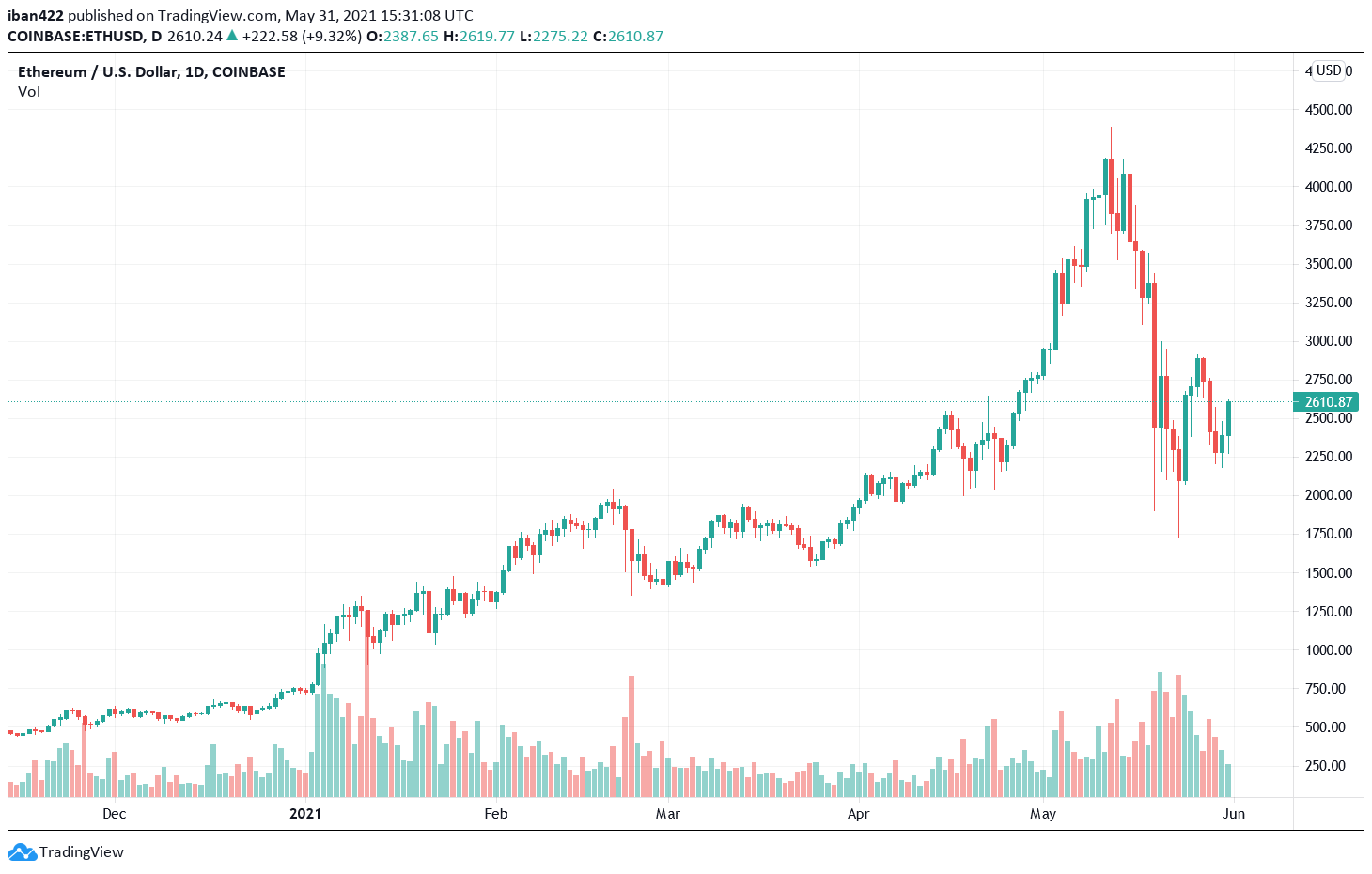
Ethereum continues to be the main driver of non-fungible tokens. | Source: ETH-USD on TradingView.com
LaMelo Ball: Career NFTs?
Just a few weeks ago, NBA guard Terry Rozier brought NFT sneakers to market that matched a pair that he wore in-game. Now, teammate and potential Rookie Of The Year star LaMelo Ball looks to get involved as well.
Ball announced limited-edition NFTs, tied to his career achievements, set to come within the next month. Ball will release 500 dynamic NFTs, and will allow owners to ‘burn’ them to potentially have physical memorabilia. He will also release 9,500 standard NFTs. Ball is teaming up with California-based design studio Playground to bring the tokens to market.
NFT Nobel Prize? Why Not, Says UC Berkeley
The University of California: Berkeley is bringing something fresh to the NFT table; in an announcement this week, the university shared that documents involved with research for two different Nobel Prize-winning discoveries would be up for 24-hour auction as NFTs. One NFT is around revolutionary discoveries in gene editing, the second in groundbreaking research in cancer immunotherapy.
Related Reading | Dynamo Kyiv To Sell NFT Tickets For 2021 Season
Featured image from Pixabay, Charts from TradingView.com
]]>
https://bitcoinist.com/nfts-in-a-nutshell-a-weekly-review-5/feed/ 0
https://bitcoinist.com/why-the-u-s-treasury-wants-brokers-to-provide-more-information-about-crypto-assets/?utm_source=rss&utm_medium=rss&utm_campaign=why-the-u-s-treasury-wants-brokers-to-provide-more-information-about-crypto-assets https://bitcoinist.com/why-the-u-s-treasury-wants-brokers-to-provide-more-information-about-crypto-assets/#respond
Sat, 29 May 2021 18:03:03 +0000
Why The U.S. Treasury Wants Brokers To Provide More Information About Crypto Assets
The United States Department of Treasury has published the “General Explanations of the Administration’s Fiscal Year” as President Joe Biden released his Budget for 2022. In its document, the Treasury claims that tax evasion using crypto assets is a “rapidly growing problem”. Therefore, they proposed to request more information from Brokers to “prevent” this alleged problem.
A Broker, according to the definition provided by the Treasury, is a dealer, barter, exchange, or person that “regularly” acts as an intermediary for a customer that transacts with crypto assets. The features of crypto assets and their digital nature allow customers to transact with offshore entities while remaining in the U.S., the Treasury claims.
Thus, these customers have opportunities to “conceal taxable income” with crypto exchanges or wallet providers. The institutions claim that crypto investors also create offshore entities to avoid tax reporting. Therefore, they deem it necessary to demand information from brokers to “bolster voluntary tax compliance”.
The Old And The New Demand For Crypto Asset Transactions
The current law gives the U.S. the privilege of receiving “certain information”, such as identity, proceeds from sales, and other information about a customer.
Crypto entities already must hold information about their clients, and many have a Know Your Customer (KYC) policy in conjunction with Anti Money Laundering measures. However, since 2020 the Treasury seeks to obtain more information from the crypto brokerage. A first proposal to monitor personal wallets or “covert” wallets was filed under Donald Trump’s administration.
It received strong pushback from the crypto community. Companies such as Coinbase, Square, Circle, and many more send their commentaries on a proposal that seemed rush and overly complicate the operations for crypto brokers.
The new law would demand brokers to report the activities on “certain beneficial owners of entities holding accounts with” them. In addition, the proposal highlighted the importance of international and states that U.S. brokers could provide information to offshore entities:
In order to ensure that the United States is able to benefit from a global automatic exchange of information framework with respect to offshore crypto assets and receive information about U.S. beneficial owners it is essential that United States reciprocally provide information on foreign beneficial owners of certain entities transacting in crypto assets with U.S. brokers.
The cooperation with offshore entities would be done on “an automatic basis”. The objective is to receive information on citizens who, directly or indirectly, “engage” in crypto assets transactions abroad. The ultimate goal is to create a “global automatic exchange of information framework”. The documents add:
The proposal, if adopted, and combined with existing law, would require a broker to report gross proceeds and such other information as the Secretary may require with respect to sales of crypto assets with respect to customers, andin the case of certain passive entities, their substantial foreign owners. The proposal would be effective for returns required to be filed after December 31, 2022.
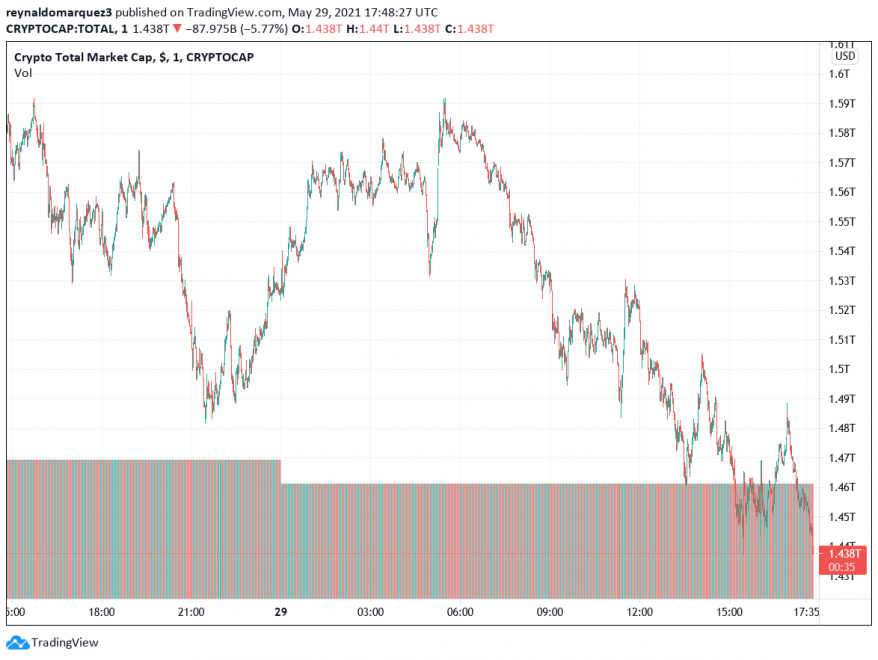
At the time of writing, the total market cap of the crypto market stands at $1,43 trillion after weeks on a downtrend. The main cryptocurrencies are in the red with the potential for further depreciation if key support levels are lost.
]]>
https://bitcoinist.com/why-the-u-s-treasury-wants-brokers-to-provide-more-information-about-crypto-assets/feed/ 0
Published at